Showing posts with label Scotland. Show all posts

Sunday, September 6, 2009

Back in the saddle after 63 years … Riding returns to Edinburgh


Back in the saddle after 63 years … Riding returns to Edinburgh

Published Date: 07 September 2009
By FIONA MACLEOD
THE clatter of hooves on cobbles filled the streets of Edinburgh yesterday as an ancient tradition that dates back to the 16th century was revived after an absence of more than 60 years.
At a stately pace, 250 elegant mounts and their smartly dressed riders took part in a procession up the Royal Mile for the city's Riding of the Marches.

The event had not taken place since 1946, when the tradition was resurrected to mark the end of the Second World War and just 70 horses took part.

From 1579 to 1718 it was an annual ceremony to mark the town boundaries and ensure no-one was encroaching on the common land. People could be fined for non-attendance.

Yesterday, thousands of onlookers watched the riders progress through the city from the Braid Hills, up the Royal Mile and down to the Grassmarket.

Such was the popularity among budding participants that the number of riders had to be capped.

Wendy Dixon, who brought her horse Tripper from Berwick-upon-Tweed for the event, said: "Riding up the Royal Mile was something you could only dream of doing before. It was a privilege to fly the flag for Berwick, a once-in-a-lifetime experience."

However, Ian Douglas, who led the ride on his grey horse Monarch, hopes the Riding of the Marches will be repeated.

He said: "I like to think it can be carried on on an annual basis. It was absolutely fantastic, a great experience. You could really sense the history.

"The 1946 ride was a bit of a one-off, but it had been held before that from 1579 to 1718."

He bore the Edinburgh banner and presented a traditional scroll to Lord Provost of the city, George Grubb. It was his suggestion to revive the tradition after being inspired by reading about previous ride-outs and council leaders thought the year of Homecoming would be suitable.

Steve McGill, first officer of the event, took part on his grey Mannie.

He said: "We were really fortunate with the weather.

"Although we had to reroute a little around Swanston as a lot of water earlier in the week had affected some of the tracks we were going to use."

And he revealed the choice of three grey mounts to lead the procession was no coincidence.

He said: "The research we did showed the leader in 1946 had a grey and we liked the idea of repeating that tradition."

At the Grassmarket, the procession delighted passengers on an open-topped tourist bus as riders inched over to let the double-decker past.

Dave Cruickshank, from Edinburgh said: "It's great if it brings the tourists to Edinburgh. My wee boy is over the moon with all the horses."

And shop worker Alex Randall was delighted to see hundreds of horses passing the door instead of the usual traffic. She offered a unique suggestion to the city's congestion problems.

She said, with tongue firmly in cheek: "It's nice to see horses. I think we should get rid of cars and have horses instead."

http://news.scotsman.com/latestnews/Back-in-the-saddle-.5622266.jp
~~~~~~~~~~~~~~~~~~~~~~~~~~~~~~~~~~~~~~~~~~~~~~~~~~~~~~~~~~~~~~~~~~~~~~~~~~~

I would have loved to see this. I think I would have wept!

-Beth

Sunday, June 7, 2009

Glowing tartan for common riding


A tailored coat and a coat and a waistcoat have been made with the tartan


A glow-in-the-dark tartan has been designed to celebrate a Scottish Borders "homecoming" event, which is to include common ridings and festivals.


The fabric, designed by a student at Heriot-Watt University and woven by Robert Noble, incorporates a reflective yarn to increase night-time safety.

During the Return to the Ridings event, 11 towns in the area will co-ordinate a series of annual ancient celebrations.

Some equestrian events will take place in the evening.

All eleven towns participating in the event were represented in the tartan with the inclusion of their colours in the tartan over-checks. Green was the main colour used to symbolise the Borders countryside.
Retroreflective yarn was twisted with wool and woven into the tartan


Robert Noble, a textile manufacturer based in Peebles, twisted Retroreflective yarn with wool and wove it into the tartan.

Alistair McDade, of Robert Noble, said: "As far as I know the use of a reflective yarn in tartan is a new concept, but it is these new ideas which help keep the Scottish Borders at the forefront of the textiles industry."

Emma Arthur-Daniels, who designed the tartan, said: "I think the final product holds true to the values of the Scottish Borders common ridings and festivals, while incorporating the new concept of weaving modern yarns into this type of fabric."

There are currently no plans to put the tartan into full production.

However, Return to the Ridings organisers said they would monitor demand and if sufficient, would consider commercial production.

Return to the Ridings is part of the Homecoming Scotland 2009 programme, which celebrates the 250th anniversary of Robert Burns' birth.

Saturday, June 6, 2009

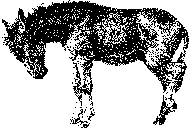
The Shetland Pony


Taken at the Royal Highland Show in Scotland in 2005


The Shetland pony is a breed of pony originating in the Shetland Isles. Shetlands range in size from a minimum height of approximately 28 inches to an official maximum height of 42 inches (10.2 hands, 107 cm) at the withers. (11.2 hands for American Shetlands) Shetland ponies have heavy coats, short legs and are considered quite intelligent. They are a very strong breed of pony, used for riding, driving, and pack purposes.


Two women of the Shetland Isles with ponies, photograph ca. 1900

Shetland ponies originated in the Shetland Isles, located northeast of mainland Scotland. Small horses lived on the Shetland Isles since the Bronze Age, and while the roots of the ancient wild pony are unknown, it is believed that they are related to the ancient Scandinavian ponies; the islands were once physically connected to Scandinavia up until the end of the last Ice Age, approximately 8000 BC.[citation needed] People who lived on the islands domesticated the animal and later crossed the native stock with ponies imported by Norse settlers. Shetland ponies also were probably influenced by the Celtic Pony, brought to the islands by the Celts between 2000 and 1000 BC. The harsh climate and scarce food developed the ponies into extremely hardy animals.

Shetland ponies were first used for pulling carts, carrying peat, coal and other items, and ploughing farmland. Then, as the Industrial Revolution increased the need for coal in the mid-19th century, thousands of Shetland ponies travelled to mainland Britain to be pit ponies, working underground hauling coal, often for their entire (often short) lives. Coal mines in the eastern United States also imported some of these animals.

The Shetland Pony Stud Book Society of the United Kingdom was started in 1890 to maintain purity and encourage high-quality animals. In 1957, the Shetland Islands Premium Stallion Scheme was formed to subsidize high-quality registered stallions to improve the breeding stock.

http://www.shetlandponystudbooksociety.co.uk/about_breed/history.aspx

The Royal Highland Show is a Treat!


The Royal Highland Show is the greatest gathering of all that is good about Scotland. It’s one of the featured events during Homecoming Scotland and is expected to attract 160,000 people over four days. The show is at the Royal Highland Showground, Ingliston from Thursday 25th June until Sunday 28th June.


http://www.royalhighlandshow.org/


Highland Show to have royal visit


The Queen was last at the Royal Highland Show 25 years ago


The Queen is to officially visit the UK's largest agricultural show for the first time since 1984.

As patron of the Royal Highland and Agricultural Society of Scotland (RHASS), she will visit The Royal Highland Show on Thursday, 24 June.

She is due to be accompanied by her daughter Princess Anne to mark the 225th anniversary of the event.

Princess Alexandra is also due to attend the Ingliston Show, which runs until Sunday 28 June.

The Queen was last at the show when it celebrated its 200th anniversary.

Ray Jones, RHASS chief executive, said: "We are delighted to welcome The Queen as our Patron in our 225th year and our other Royal visitors.

"The Royal family have been strong supporters of the society and its activities over the years and we look forward to pointing out some of the show highlights."

The Queen's father King George VI bestowed the title "Royal" on the show at the Inverness event in 1948, in the days when the event moved around Scotland each year before settling at its current home in 1960.

http://news.bbc.co.uk/2/hi/uk_news/scotland/edinburgh_and_east/8084691.stm
~~~~~~~~~~~~~~~~~~~~~~~~~~~~~~~~~~~~~~~~~~~~~~~~~~~~~~~~~~~~~~~~~~~~~~~~~~~~~~~~~~


I spent two days at the Royal Highland Show in 2005. I would love to be there this year. What a wonderful event this is. I feel very lucky I could take in the show.


Thursday 25th June until Sunday 28th June, 2009.
http://www.royalhighlandshow.org/

Thursday, April 16, 2009

Hoofprint to History

Donkeys delight church audience
service adds hoofprint to history

By Alistair Beaton

Published: 06/04/2009

THE Auld Kirk of Inverurie added a new hoofprint in church history during yesterday’s Palm Sunday service as a pair of donkeys joined in a procession down the aisle.

Donkeys Jane and Jill pricked up their ears at the sound of the opening 10am hymn, but stepped quietly through the doors of St Andrew’s Church to join the Rev Graeme Longmuir in front of the surprised – but still singing – congregation.

An image of Christ on a donkey had been projected on the wall above and candles shone in the 168-year-old church, as the young donkeys flanked the minister.

The 11-month-old pair barely flicked a tail before afterwards returning through the pews to the west door, the sound of their hooves muffled by carpet rather than Biblical palms.

Mr Longmuir reflected on the meaning and message of Palm Sunday, and church members joined in Hymn 366 – “come to where the crowds will be, see a strange and gentle king, on a donkey travelling”.

Jane and Jill were rewarded outside with a feed and drink, and loaded into a trailer for their journey home.

The donkeys had made their pilgrimage to the church from Braeriach, near Echt. Owner Netta Sangster said: “I thought the music might be worrying Jane and Jill to begin with, but they were no bother.

http://www.pressandjournal.co.uk/Article.aspx/1157034?UserKey=

Thursday, April 9, 2009

Christ of St John of the Cross


Salvador Dali's "Christ of St John of the Cross

Salvador Dali’s ‘Christ of St John of the Cross’ caused controversy and consternation when it was first purchased for the city of Glasgow, Scotland in 1951 by the then Director of Glasgow Museums, Dr. Tom Honeyman.

An art dealer with an open-minded approach to art appreciation, Honeyman saw the picture for sale at the Lefevre Gallery in London and was convinced that it was a picture that Glasgow must have.

Although the catalogue price was £12,000, Honeyman used his connections and undoubted charm and beat this down to £8,200, which just happened to be the last of the funds left from the profits in the 1901 Exhibition Fund.

In addition, he secured the copyright to the image from the artist, which was (and is) often difficult to do.

But instead of Honeyman being carried shoulder high in victory at his coup, there was an instant outcry from almost every quarter. The art establishment regarded Dali’s super-realism and uncharacteristic choice of subject as ephemeral, cynical and lacking any depth or meaning. Students at the Glasgow School of Art protested that the cash should have been spent on young local artists.

Even highly esteemed artists such as Augustus John deplored the ‘mad price’ being paid to a living painter.

Honeyman, however, was proved not only right but also spectacularly astute. The public flocked to see the painting.

Such is the polarized emotional response that visitors experience when viewing the painting that it has been attacked twice. However, Kelvingrove conservators expertly repaired the damage, and the non-professional eye would now find it hard to spot the wounds.

http://www.seeglasgow.com/seeglasgow/museums-and-galleriesnew/kelvingrove/salvador-dali

Last Supper window St. Giles Cathedral, Edinburgh

I had the joy of seeing these windows in June of 2005 when I visited Scotland for the first time. My friend Mike Abrams took me to St. Giles where I spent quite a bit of time taking pictures. Mike took this photo of me taking pictures.


Last Supper window St. Giles Cathedral, Edinburgh

Noel Paton


by Sir Joseph Noel Paton RSA (1821-1901)
~~~~~~~~~~~~~~~~~~~~~~~~~~~~~~~~~~~~~~~~~~~~~~~~~~

Joseph Noel Paton was a Scottish painter, born in Dunfermline, Scotland to a family of weavers. He studied at the Royal Academy, London, and became a painter of historical, fairy, allegorical and religious subjects, in a style close to that of the Pre-Raphaelites. He was appointed Queen's Limner for Scotland from 1866. He also published two volumes of poems.

About Me

My photo
I grew up in Chautauqua County, NY. I graduated from Edinboro University of Pennyslvania in 1981 with a BFA in Jewelry and Metalworking. I have been married 31 years. I currently run a small business with my husband. We both enjoy the outdoors and animals a great deal and live on a tiny farm in Western, NY.