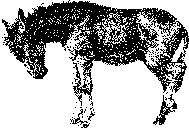
Welcome to the Peddlers Donkey Blog. The humble donkey has served mankind for thousands of years. This blog is a tribute to the much misunderstood ass.
Carl Heinrich Bloch (May 23, 1834 – February 22, 1890) was a Danish painter.
He was born in Copenhagen and studied with Wilhelm Marstrand at the Royal Danish Academy of Art (Det Kongelige Danske Kunstakademi) there.
His early work featured rural scenes from everyday life. From 1859 to 1866, Bloch lived in Italy, and this period was important for the development of his historical style.
His first great success was the exhibition of his "Prometheus Unbound" in Copenhagen in 1865. After the death of Marstrand, he finished the decoration of the ceremonial hall at the University of Copenhagen.
He was then commissioned to produce 23 paintings for the Chapel at Frederiksborg Palace. These were all scenes from the life of Christ which have become very popular as illustrations. The originals, painted between 1865 and 1879, are still at Frederiksborg Palace.
(G) The day that (G*)Jesus a(C)rrived in Jer(D*)usalem, The ad(G)venture almost (G*)over, the (C)night he hadn't (D)slept (G)Dreams and premo(G*)nitions made him (C)tired and e(D*)motional, (G)And that's why (C)Je(D)sus (G)wept.
He wasn't scared of dying, he'd made that commitment Fulfilling the old prophecy, his bargain he had kept He was due some satisfaction, but he was deeply troubled, And that's why Jesus wept.
Was this his true destiny, or could he still make changes, Someone else's nightmare into which he'd stepped? Damage limitation couldn't save the situation, And that's why Jesus wept.
In his dream he saw the crusade and all wars that would follow, Declared in his name when he thought he'd been direct Love thy neighbour, do not kill, and turn the other cheek, And that's why Jesus wept.
He (C)saw the inqui(G)sition and the (C)burning of the (G)saints, The con(C)version of the (G)innocents he (C*)swore he would pro(D)tect He (G)saw them bless the (G*)bomb that was (C)dropped on Hiro(D*)shima, And (G)that's why (C)Je(D)sus (G)wept.
Though Peter would betray him, he made him the rock On which he would build his church to sort of keep him in his debt A man about to die is allowed some confusion, And that's why Jesus wept.
He thought of his disciples, especially of Judas, The job that was ordained for him and the reward he'd collect He saw him in the tree with the silver coins around him, And that's why Jesus wept.
Then he thought about the good times when he turned the tables over, Chastised the money lenders and he earned the boy's respect He was proud of Godly anger, but ashamed of manly temper, And that's why Jesus wept.
Rumours started flying about water into wine, Sight to the blind and that he'd even raised the dead The biggest miracle was that anyone believed it, And that's why Jesus wept.
Then he mused on human nature, how fickle were the public, So ready to accept him, so quick now to reject Where were the five thousand he fed with loaves and fishes? And that's why Jesus wept.
In his dream he saw a garden with all his friends asleep, He walked away the hours until the morning crept He wondered would the nails hurt, would he be man enough? And that's why Jesus wept.
Was he supposed to bear it like a man or like a God, Would tears show a weakness or a strength by their effect? Would they be viewed as compassion or failure and self-pity? And that's why Jesus wept.
Then he saw his houses burning on both sides of a border, Saw the guiltless suffer with the guilty and the rest And when they called his name and he knew he couldn't help them, That's why Jesus wept.
Then he saw two armies marching and he heard their crucifixes Reduced to superstitious muted jangling round their necks And he heard his name intoned as they interred their companion, And that's why Jesus wept.
Then he thought about his mother and the stories she had told him, Who'd filled his dreams with angels, put voices in his head Then the scent of pine trees made him think of dear old Joseph, And that's why Jesus wept.
Am I a stone and not a sheep That I can stand, O Christ, beneath Thy Cross, To number drop by drop Thy Blood's slow loss, And yet not weep? Not so those women loved Who with exceeding grief lamented Thee; Not so fallen Peter weeping bitterly; Not so the thief was moved; Not so the Sun and Moon Which hid their faces in a starless sky, A horror of great darkness at broad noon— I, only I. Yet give not o'er, But seek Thy sheep, true Shepherd of the flock; Greater than Moses, turn and look once more And smite a rock.
Christ and Thorns Carl Heinrich Bloch (Born 23 May 1834- Died 22 February 1890) ~~~~~~~~~~~~~~~~~~~~~~~~~~~~~~~~~~~~~~~~~~~~~~~~~~~~~~~~~~~ Matthew 27: 29 And when they had platted a crown of thorns, they put it upon his head, and a reed in his right hand: and they bowed the knee before him, and mocked him, saying, Hail, King of the Jews!
Salvador Dali’s ‘Christ of St John of the Cross’ caused controversy and consternation when it was first purchased for the city of Glasgow, Scotland in 1951 by the then Director of Glasgow Museums, Dr. Tom Honeyman.
An art dealer with an open-minded approach to art appreciation, Honeyman saw the picture for sale at the Lefevre Gallery in London and was convinced that it was a picture that Glasgow must have.
Although the catalogue price was £12,000, Honeyman used his connections and undoubted charm and beat this down to £8,200, which just happened to be the last of the funds left from the profits in the 1901 Exhibition Fund.
In addition, he secured the copyright to the image from the artist, which was (and is) often difficult to do.
But instead of Honeyman being carried shoulder high in victory at his coup, there was an instant outcry from almost every quarter. The art establishment regarded Dali’s super-realism and uncharacteristic choice of subject as ephemeral, cynical and lacking any depth or meaning. Students at the Glasgow School of Art protested that the cash should have been spent on young local artists.
Even highly esteemed artists such as Augustus John deplored the ‘mad price’ being paid to a living painter.
Honeyman, however, was proved not only right but also spectacularly astute. The public flocked to see the painting.
Such is the polarized emotional response that visitors experience when viewing the painting that it has been attacked twice. However, Kelvingrove conservators expertly repaired the damage, and the non-professional eye would now find it hard to spot the wounds.
I grew up in Chautauqua County, NY. I graduated from Edinboro University of Pennyslvania in 1981 with a BFA in Jewelry and Metalworking. I have been married 31 years. I currently run a small business with my husband. We both enjoy the outdoors and animals a great deal and live on a tiny farm in Western, NY.
May the frost never afflict your spuds, may the outside leaves of your cabbage always be free of worms, may the crows never pick your haystack, and may your donkey always be in foal