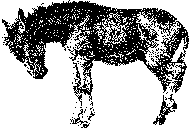
Welcome to the Peddlers Donkey Blog. The humble donkey has served mankind for thousands of years. This blog is a tribute to the much misunderstood ass.
12. When Jesus spoke again to the people, he said, "I am the light of the world. Whoever follows me will never walk in darkness, but will have the light of life."
Christ and the Disciples at Emmaus Oil on canvas Carnegie Museum of Art, Pittsburgh, Pennsylvania, USA Pascal-Adolphe-Jean Dagnan-Bouveret born 1852 - died 1929
(The Deposition of Christ), a painting by Antonio Ciseri.
~~~~~~~~~~~~~~~~~~~~~~~~~~~~~~~~~~~~~~~~~~~~~~~~~~~~~~~~~~~~~~~~~~~~~~~~~ Antonio Ciseri (October 25, 1821 – March 8, 1891) was a Swiss artist.
Ciseri was born in Ronco sopra Ascona in the canton of Ticino in Switzerland. In 1833 he moved with his father to Florence. He was admitted in 1834 to the Accademia di Belle Arti, where he trained under Niccola Benvenuti. His religious paintings are Raphaelesque in their compositional outlines and their polished surfaces, but are nearly photographic in effect. He fulfilled many important commissions from churches in Italy and Switzerland. Ciseri also painted a significant number of portraits. He died in Florence on March 8, 1891.
When it was evening, there came a rich man from Arimathea, named Joseph, who was also a disciple of Jesus. He went to Pilate and asked for the body of Jesus; then Pilate ordered it to be given to him. So Joseph took the body and wrapped it in a clean linen cloth and laid it in his own new tomb, which he had hewn in the rock. He then rolled a great stone to the door of the tomb and went away. Mary Magdalene and the other Mary were there, sitting opposite the tomb.
The next day, that is, after the day of Preparation, the chief priests and the Pharisees gathered before Pilate and said, "Sir, we remember what that impostor said while he was still alive, `After three days I will rise again.' Therefore command the tomb to be made secure until the third day; otherwise his disciples may go and steal him away, and tell the people, `He has been raised from the dead,' and the last deception would be worse than the first." Pilate said to them, "You have a guard of soldiers; go, make it as secure as you can." So they went with the guard and made the tomb secure by sealing the stone.
Carl Heinrich Bloch (May 23, 1834 – February 22, 1890) was a Danish painter.
He was born in Copenhagen and studied with Wilhelm Marstrand at the Royal Danish Academy of Art (Det Kongelige Danske Kunstakademi) there.
His early work featured rural scenes from everyday life. From 1859 to 1866, Bloch lived in Italy, and this period was important for the development of his historical style.
His first great success was the exhibition of his "Prometheus Unbound" in Copenhagen in 1865. After the death of Marstrand, he finished the decoration of the ceremonial hall at the University of Copenhagen.
He was then commissioned to produce 23 paintings for the Chapel at Frederiksborg Palace. These were all scenes from the life of Christ which have become very popular as illustrations. The originals, painted between 1865 and 1879, are still at Frederiksborg Palace.
(G) The day that (G*)Jesus a(C)rrived in Jer(D*)usalem, The ad(G)venture almost (G*)over, the (C)night he hadn't (D)slept (G)Dreams and premo(G*)nitions made him (C)tired and e(D*)motional, (G)And that's why (C)Je(D)sus (G)wept.
He wasn't scared of dying, he'd made that commitment Fulfilling the old prophecy, his bargain he had kept He was due some satisfaction, but he was deeply troubled, And that's why Jesus wept.
Was this his true destiny, or could he still make changes, Someone else's nightmare into which he'd stepped? Damage limitation couldn't save the situation, And that's why Jesus wept.
In his dream he saw the crusade and all wars that would follow, Declared in his name when he thought he'd been direct Love thy neighbour, do not kill, and turn the other cheek, And that's why Jesus wept.
He (C)saw the inqui(G)sition and the (C)burning of the (G)saints, The con(C)version of the (G)innocents he (C*)swore he would pro(D)tect He (G)saw them bless the (G*)bomb that was (C)dropped on Hiro(D*)shima, And (G)that's why (C)Je(D)sus (G)wept.
Though Peter would betray him, he made him the rock On which he would build his church to sort of keep him in his debt A man about to die is allowed some confusion, And that's why Jesus wept.
He thought of his disciples, especially of Judas, The job that was ordained for him and the reward he'd collect He saw him in the tree with the silver coins around him, And that's why Jesus wept.
Then he thought about the good times when he turned the tables over, Chastised the money lenders and he earned the boy's respect He was proud of Godly anger, but ashamed of manly temper, And that's why Jesus wept.
Rumours started flying about water into wine, Sight to the blind and that he'd even raised the dead The biggest miracle was that anyone believed it, And that's why Jesus wept.
Then he mused on human nature, how fickle were the public, So ready to accept him, so quick now to reject Where were the five thousand he fed with loaves and fishes? And that's why Jesus wept.
In his dream he saw a garden with all his friends asleep, He walked away the hours until the morning crept He wondered would the nails hurt, would he be man enough? And that's why Jesus wept.
Was he supposed to bear it like a man or like a God, Would tears show a weakness or a strength by their effect? Would they be viewed as compassion or failure and self-pity? And that's why Jesus wept.
Then he saw his houses burning on both sides of a border, Saw the guiltless suffer with the guilty and the rest And when they called his name and he knew he couldn't help them, That's why Jesus wept.
Then he saw two armies marching and he heard their crucifixes Reduced to superstitious muted jangling round their necks And he heard his name intoned as they interred their companion, And that's why Jesus wept.
Then he thought about his mother and the stories she had told him, Who'd filled his dreams with angels, put voices in his head Then the scent of pine trees made him think of dear old Joseph, And that's why Jesus wept.
Salvador Dali’s ‘Christ of St John of the Cross’ caused controversy and consternation when it was first purchased for the city of Glasgow, Scotland in 1951 by the then Director of Glasgow Museums, Dr. Tom Honeyman.
An art dealer with an open-minded approach to art appreciation, Honeyman saw the picture for sale at the Lefevre Gallery in London and was convinced that it was a picture that Glasgow must have.
Although the catalogue price was £12,000, Honeyman used his connections and undoubted charm and beat this down to £8,200, which just happened to be the last of the funds left from the profits in the 1901 Exhibition Fund.
In addition, he secured the copyright to the image from the artist, which was (and is) often difficult to do.
But instead of Honeyman being carried shoulder high in victory at his coup, there was an instant outcry from almost every quarter. The art establishment regarded Dali’s super-realism and uncharacteristic choice of subject as ephemeral, cynical and lacking any depth or meaning. Students at the Glasgow School of Art protested that the cash should have been spent on young local artists.
Even highly esteemed artists such as Augustus John deplored the ‘mad price’ being paid to a living painter.
Honeyman, however, was proved not only right but also spectacularly astute. The public flocked to see the painting.
Such is the polarized emotional response that visitors experience when viewing the painting that it has been attacked twice. However, Kelvingrove conservators expertly repaired the damage, and the non-professional eye would now find it hard to spot the wounds.
Jesus in the Garden of Gethsemane, from the Trebon Altarpiece, circa 1380
he Master of the Třeboň Altarpiece, sometimes called the Master of Wittingau, was a Bohemian painter active in Prague around 1380-1390. His name is derived from an altarpiece from the church of Saint Eligius at the Augustinian convent of Třeboň (known in German as "Wittingau"). The altarpiece, a triptych, depicts Christ on the Mount of Olives, The Tomb of Christ, and the Resurrection. It has been dated to around 1380, and is today held at the Convent of St. Agnes branch of the National Gallery in Prague.
Stylistically, the Master seems to have been aware of French painting; in addition, the influence of northern Italian art may be seen in his work. He created the so-called "beautiful style", a Bohemian variant of the International Gothic style in which figures are placed in deep settings and modeled with chiaroscuro; such intensity had never before been seen in Bohemian art, but would be prominent in the work of future generations of artists. In addition, his influence can be seen in the work of other European artists of the period, most especially the Master of the Bamberg Altar.
by Sir Joseph Noel Paton RSA (1821-1901) ~~~~~~~~~~~~~~~~~~~~~~~~~~~~~~~~~~~~~~~~~~~~~~~~~~
Joseph Noel Paton was a Scottish painter, born in Dunfermline, Scotland to a family of weavers. He studied at the Royal Academy, London, and became a painter of historical, fairy, allegorical and religious subjects, in a style close to that of the Pre-Raphaelites. He was appointed Queen's Limner for Scotland from 1866. He also published two volumes of poems.
He riseth from supper, and laid aside his garments; and took a towel, and girded himself. After that he poureth water into a bason, and began to wash the disciples' feet, and to wipe them with the towel wherewith he was girded. Then cometh he to Simon Peter: and Peter saith unto him, Lord, dost thou wash my feet? Jesus answered and said unto him, What I do thou knowest not now; but thou shalt know hereafter. Peter saith unto him, Thou shalt never wash my feet. Jesus answered him, If I wash thee not, thou hast no part with me. Simon Peter saith unto him, Lord, not my feet only, but also my hands and my head.
Jesus Washing Peter's Feet. 1852-56 by Ford Madox Brown
This picture illustrates the biblical story of Christ washing his disciples’ feet at the Last Supper. It has an unusually low viewpoint and compressed space. Critics objected to the picture’s coarseness – it originally depicted Jesus only semi-clad. This caused an outcry when it was first exhibited and it remained unsold for several years until Ford Madox Brown reworked the figure in robes.Brown was never invited to join the Pre-Raphaelite Brotherhood but he was a close associate of the group. Several members modelled for the disciples in this picture and the critic F G Stephens sat for Christ.
Ford Madox Brown (16 April 1821 – 6 October 1893) was an English painter of moral and historical subjects, notable for his distinctively graphic and often Hogarthian version of the Pre-Raphaelite style. While he was closely associated with the Pre-Raphaelite Brotherhood, he was never actually a member. Nevertheless, he remained close to Dante Gabriel Rossetti, with whom he also joined William Morris's design company, Morris, Marshall, Faulkner & Co., in 1861.
(b. ca. 1240, Firenze, d. ca. 1302, Firenze) Several frescoes in the upper church of San Francesco are attributed to Cimabue. The attribution of this fresco, located on the left wall of the church, is doubtful. Traditionally it was attributed to Cavallini. Other assumptions are that it was executed under the supervision of Cimabue, or it is the work of an unknown master strongly influenced by Cimabue, Cavallini and Torriti.
Barna da Siena, also known as Barna di Siena, was a Sienese painter active from about 1330 to 1350, and was the painter in Siena during this period. He learned his trade from Simone Martini. Barna is believed to have paint the frescoes depicting the life of Jesus in the Collegiata di San Gimignano and is generally credited with Christ Bearing the Cross, with a Dominican Friar in the Frick Collection in New York City. He was killed in a fall from the scaffolding. Barna's figures are more dramatic and vigorous than any in previous Sienese painting.
Seville's Cathedral occupies the site of a great mosque in the late 12th century. Later, Christian architects added the extra dimension of height. Its central nave rises to an awesome 42 metres and even the side chapels seem tall enough to contain an ordinary church. The total area covers 11,520 square metres and new calculations, based on cubic measurements, have now pushed it in front of Saint Paul's in London and Saint Peter's in Rome, as the largest church in the world.
(Les Très Riches Heures du duc de Berry, Folio 173v - The Entry into Jerusalem the Musée Condé, Chantilly.
The Très Riches Heures du Duc de Berry is usually referred to as "le roi des manuscrits enluminés" or "the king of the illuminated manuscripts", but it is also a pinnacle in the entire history of painting. Commissioned by Jean, Duc de Berry in 1413, it was painted by the Limbourg brothers who left it unfinished at their (and the Duc's) death in 1416. The Duc Charles I de Savoie commissioned Jean Colombe to complete the painting of the manuscript between 1485-1489. The typical medieval manuscript called a book of hours is an abbreviated form of the breviary which contained the Divine Office recited in monasteries. The books of hours were composed for the lay people who wished to incorporate elements of monasticism into their devotional life. Reciting the hours typically centered upon the recitation or singing of a number of psalms, accompanied by set prayers.
Life of Christ Window (c.1150): Triumphal Entry ~~~~~~~~~~~~~~~~~~~~~~~~~~~~~~~~~~~~~~~~~~~~~~~~~~~~~~~~~~~~~~~~~~~~~~~~~~~~~
Hosanna to the Son of David. Blessed is he who comes in the name of the Lord. Behold your king comes to you, O Zion, meek and lowly, sitting upon an ass. Ride on in the cause of truth and for the sake of justice. Your throne is the throne of God, it endures for ever; and the sceptre of, your kingdom is a righteous sceptre. You have loved righteousness and hated evil: therefore God, your God, has anointed you with the oil of gladness above your fellows. Hosanna to the Son of David. Blessed is he who comes in the name of the Lord.
I grew up in Chautauqua County, NY. I graduated from Edinboro University of Pennyslvania in 1981 with a BFA in Jewelry and Metalworking. I have been married 31 years. I currently run a small business with my husband. We both enjoy the outdoors and animals a great deal and live on a tiny farm in Western, NY.
May the frost never afflict your spuds, may the outside leaves of your cabbage always be free of worms, may the crows never pick your haystack, and may your donkey always be in foal