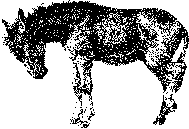
This one is my favorite because Jesus looks so happy and the donkey has huge ears!
Wednesday, March 25, 2009
More Shrovetide Characters

Palmesel
Lindenwood and polychromy
Germany, Lower Franconia, ca. 1470-1480
Said to be from the church at Mellrichstadt in Bavaria (Unterfranken), north of Schweinfurt
The German word Palmesel (palm donkey) refers to the statue of Christ on a donkey, mounted on a wheeled platform, which was part of Palm Sunday processions in many German-speaking regions until the Reformation. In the Middle Ages these processions, which reenacted Christ's entry into Jerusalem mounted on an ass, were lively pageants in which hymns were sung, palms strewn, and clothes spread on the ground before the Palmesel. The figure of Christ retains, in contrast, an air of quiet majesty. The donkey's hooves and the fingers on Christ's hands are restored; the platform and wheels are modern.
The Cloisters Collection, 1955 (55.24)
The Cloisters, a branch of the New York Metropolitan Museum of Art dedicated to the art and architecture of the European Middle Ages, is located in Fort Tryon Park near the northern tip of Manhattan island on a hill overlooking the Hudson River. The Cloisters collection contains approximately five thousand European medieval works of art, with a particular emphasis on pieces dating from the twelfth through the fifteen centuries.
Labels:
Austria,
Germany,
Jesus,
palm donkey,
Palm Sunday,
Palmesel,
Shrove figures
Shrovetide characters and the famous Palm procession
The Hall-Wattens region of Austria is proud of its cultural heritage - in both religious and secular respects. In rural parts many customs have been protected and are still nurtured to this day.
Thaur, in particular, with its tradition of crib-carving, the "Mullerlaufen" Shrovetide characters and the famous Palm procession, has made quite a name for itself.
For more than 200 years, a traditional Christ on a Donkey procession has been staged in Thaur. This custom, which used to be performed in many places, was successfully revived in Hall a few decades ago.
Towards the end of the Middle Ages, almost every village had its own palm donkey for the Palm procession, a ritual symbolising Christ's arrival in Jerusalem. Often it was a life-sized model donkey, upon which a carving of Christ was often seated. The procession with the palm donkey was once widespread not only in the southern parts of the German-speaking world, but also in some Dutch and Belgian regions.
People also used to sit on a donkey among "Christ's followers". In the first year after their election, Salzburg's archbishops would join in the palm procession to the Nonnbergkirche − not on a lowly donkey, but on a white horse.
According to a report of 1785, in the area around Salzburg and in southern Bavaria, children were allowed to ride on a live palm donkey until the Council of Cardinals banned the "Donkey Festival". Usually wooden donkeys, decoratively adorned and with a seated Christ figure, were placed on a float and pulled along in the procession.
At the start of the 19th century, a very special, and much admired, processional donkey, was kept under Salzburg's Nonnberger Gate. The wooden creature was thought to have miraculous powers as it had special device, which cast out figs and locust beans.
Most of these donkeys fell victim to the iconoclastic fervour of the Reformation. Those donkeys that survived the upheaval were finally banished during the Enlightenment at the end of the 18th century.
http://www.regionhall.at/en/christ-donkey-procession.html
Thaur, in particular, with its tradition of crib-carving, the "Mullerlaufen" Shrovetide characters and the famous Palm procession, has made quite a name for itself.
For more than 200 years, a traditional Christ on a Donkey procession has been staged in Thaur. This custom, which used to be performed in many places, was successfully revived in Hall a few decades ago.
Towards the end of the Middle Ages, almost every village had its own palm donkey for the Palm procession, a ritual symbolising Christ's arrival in Jerusalem. Often it was a life-sized model donkey, upon which a carving of Christ was often seated. The procession with the palm donkey was once widespread not only in the southern parts of the German-speaking world, but also in some Dutch and Belgian regions.
People also used to sit on a donkey among "Christ's followers". In the first year after their election, Salzburg's archbishops would join in the palm procession to the Nonnbergkirche − not on a lowly donkey, but on a white horse.
According to a report of 1785, in the area around Salzburg and in southern Bavaria, children were allowed to ride on a live palm donkey until the Council of Cardinals banned the "Donkey Festival". Usually wooden donkeys, decoratively adorned and with a seated Christ figure, were placed on a float and pulled along in the procession.
At the start of the 19th century, a very special, and much admired, processional donkey, was kept under Salzburg's Nonnberger Gate. The wooden creature was thought to have miraculous powers as it had special device, which cast out figs and locust beans.
Most of these donkeys fell victim to the iconoclastic fervour of the Reformation. Those donkeys that survived the upheaval were finally banished during the Enlightenment at the end of the 18th century.
http://www.regionhall.at/en/christ-donkey-procession.html
Labels:
Austria,
Germany,
Jesus,
palm donkey,
Palm Sunday,
Palmesel,
Shrove figures
Heaven on Wheels???

South Germany
Last fourth of the 15th century
Polychromous lime tree
H. 1.22 m; L. 1 m; Pr. 0.44 m
Old collection W. Hoffstatter
Bought with the help
of the Association for
the Enlightening of
the National Museum of the Middle Age (ARMMA)
Cl. 23799
Christ of the Palms

Musée de Cluny, Paris
Statue on wheels of Christ and the donkey, used in Holy Week processions to depict the Triumphal Entry.
The representations of the Christ of the Palms in the round, placed on the wheeled carts, and designed to be moved when there were processions, are one of most typical and remarkable productions of the south west provinces of Germany between the end of the 12th century and the end of the 16th century, the Reformation or the Counter Reformation, having ended this type of work..
At first analysis, the work is made of seventeen pieces of wood: the board and the four wheels, the four legs of the donkey, its tail, its ears, Christ’s left hand, his two feet, and two more important pieces; one making the donkey's body and the lower part of Christ's, and the other the torso and the head. These two pieces are joined to a third one which is relatively thin. The donkey’s tail and Christ’s left hand are modern pieces fixed with internal screws. The feet were assembled with nails, but one of them has been repaired. The other pieces were assembled with plugs or mortice and tenon. The work, although it has been repainted, retains patches of the original polychromy (Christ's head, the lining of the dress, possible the carnations in the right hand, the braid, and part of the donkey's hair).
Christ is sculpted nervously and sharply, conferring to the piece a majesty that compensates for the slightly clumsy character of the donkey. The incorporation of this work of art in the collection of the National Museum of the Middle Ages illustrates one of the most remarkable forms of medieval devotion, the use of animated sculptures to represent certain parts of the Biblical story, especially around the cycle of Easter. Already known in Jerusalem in the 4th century, the Palm Sunday procession takes a new dimension in the 10th century when, as noted in the life of Ulrich , bishop of Augsburg, clerics introduced into it a new element, a sculpture representing Christ sitting on his donkey, placed on a carriage or on wheels, which was taken in procession from a church which represented the Mount of Olives, to another church representing Saint Sepulcher, the destination of the hyerosolimitan processions. Although the oldest examples, like the Steinen one in the Suisse National Museum of Zurich, were made in the 12th century, most of the those which have survived belong to the same period as the one just acquired by the museum, i.e. the 15th century and beginning of the and 16th century.
http://www.musee-moyenage.fr/ang/pages/page_id18570_u1l2.htm
Labels:
Austria,
Germany,
Jesus,
Lent,
palm donkey,
Palm Sunday,
Palmesel,
Shrove figures
Saturday, February 21, 2009
T.S. Cooper, Again!

Thomas Sidney Cooper (September 26, 1803 - February 7, 1902) was an English painter noted for his images of cattle and farm animals.
Cooper was born at Canterbury, Kent, and as a small child he began to show strong artistic inclinations, but the circumstances of his family did not allow him to received any systematic training. By the time he was twelve years old, he was working in the shop of a coach painter. Later he obtained a job as a scene painter; and he alternated between these two occupations for about eight years. He still felt a desire to become an artist, and all his spare moments were spent drawing and painting from nature. At the age of twenty he went to London, drew for a while in the British Museum, and was admitted as a student of the Royal Academy.
He then returned to Canterbury, where he was able to earn a living as a drawing-master and by the sale of sketches and drawings. In 1827 he settled in Brussels; but four years later he returned to London to live, and by showing his first picture at the Royal Academy (1833) began an unprecedentedly prolonged career as an exhibitor. Cooper's name is mainly associated with pictures of cattle or sheep, a fact that earned him the epithet 'Cows Cooper'. Cooper collaborated with Frederick Richard Lee R.A. on several paintings, Lee undertaking the landscapes, and Cooper adding animals to complete the scene.
Saturday, February 14, 2009
Subscribe to:
Posts (Atom)
About Me
- Gimmer
- I grew up in Chautauqua County, NY. I graduated from Edinboro University of Pennyslvania in 1981 with a BFA in Jewelry and Metalworking. I have been married 31 years. I currently run a small business with my husband. We both enjoy the outdoors and animals a great deal and live on a tiny farm in Western, NY.